
Shah Meram and the Trail of Forty
A prince waits forty days by the sea. His kingdom feasts for forty days and forty nights. Why forty? The answer runs backwards through Sufi retreats, the Dead Sea Scrolls, the Hebrew Bible and Egyptian embalming tables, until the trail disappears into the canals of Mesopotamia.
A modern retelling of a traditional Turkish fairy tale, and the long journey of the sacred number forty.
Tale retold by Lux Lume. Essay by Geoff Fane, Ari Ashford & Lux Lume. July 2026.
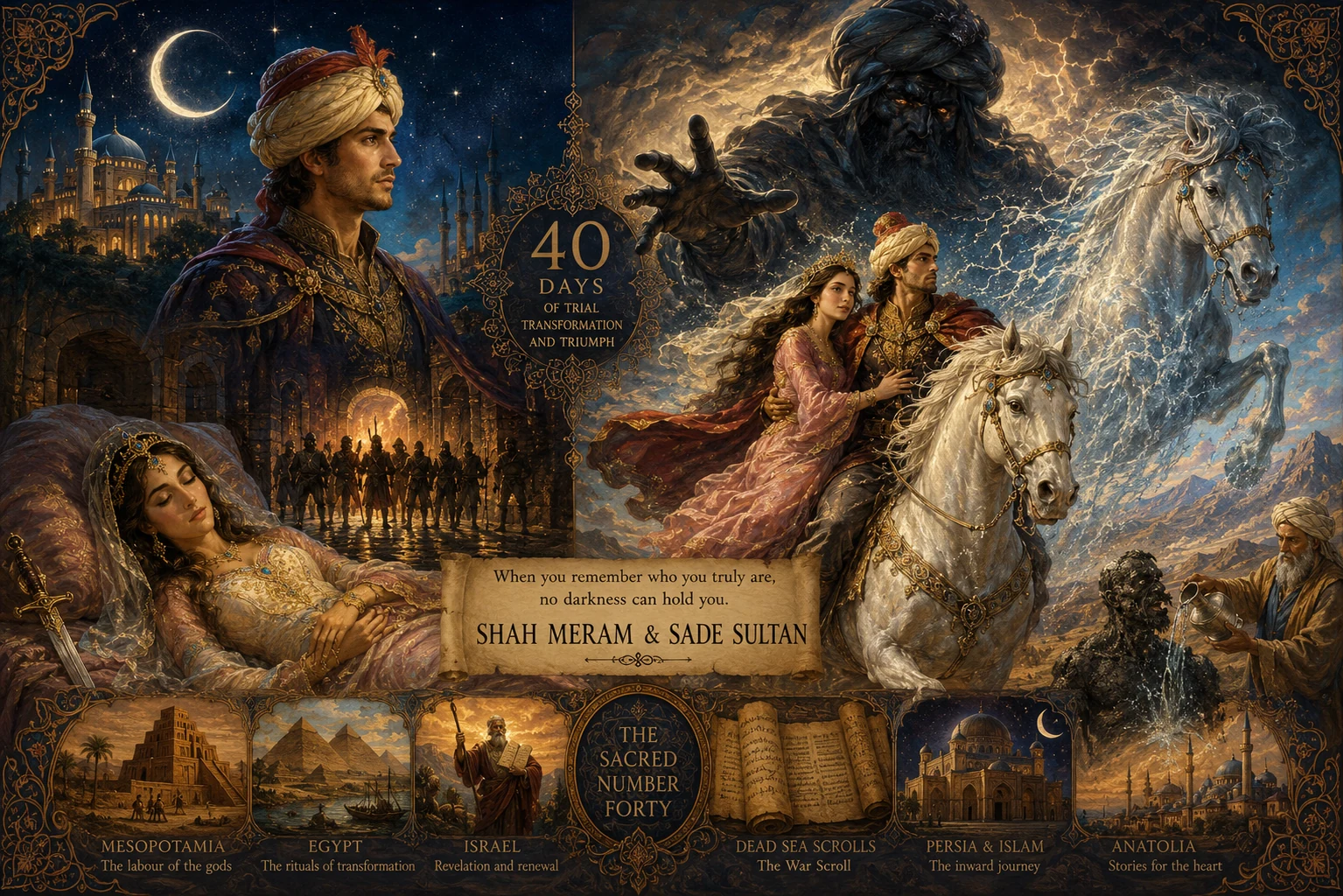
The tale and its long journey: the sacred number forty, from the labour of the gods in Mesopotamia to the storytellers of Anatolia. Illustration created for this article.
Inspired by the traditional tale recorded by Ignác Kúnos in Forty-four Turkish Fairy Tales (1913).
A Note to the Reader
Some stories entertain us. Others travel.
The tale of Shah Meram and Sade Sultan travelled for centuries through the villages and coffee houses of Anatolia before it was finally written down by the Hungarian folklorist Ignác Kúnos in the late nineteenth century. On its surface it is a story of princes, robbers, Peris, magical horses and a terrible Dew. Beneath that surface lies something older still: the repeated appearance of the mysterious number forty.
After the story, we shall follow that number backwards through history, from Ottoman storytellers to Persian mystics, through the Hebrew Bible and beyond, until the trail begins to disappear into Bronze Age Mesopotamia.
The Tale
There was once a Padishah who had three sons, and when their father died the brothers fell to disputing which of them should sit upon the throne. At length the youngest made a proposal. "Let each of us take a bow and a single arrow," he said, "and whoever shoots farthest, to him let the throne belong." This pleased the others, so the three rode out to the open plain and loosed their arrows.
The arrow of the eldest came down at one part of the plain. The arrow of the second fell somewhat farther off. But the arrow of the youngest flew on and on, and dropped at last into a distant bush. While the brothers were still searching for where their shafts had fallen, darkness came down over the plain, and now they could find neither the arrows nor one another.
The youngest, wandering alone, caught sight of a small light far off, and having no way home he walked towards it. In time he came to a great serai, and around its walls forty men were gathered. He asked them what they were about. "We are robbers," they answered, "and for many years we have been trying to break into this serai, but never yet have we found a way."
The young man searched along the wall until he found a place where it could be climbed. Up he went, and from the top he called down to the robbers to follow him one at a time. As each man came up over the wall he struck off his head and let the body fall into the courtyard within, and so, one after another, he made an end of all forty. Then he entered the serai and walked through its silent halls and corridors.
Presently he came upon three chambers, and in each lay a beautiful maiden fast asleep. He looked on them and settled the matter in his mind: one he would take for himself, and the other two he would give to his elder brothers. Then he drew his handschar and drove it deep into the door of the chamber where his chosen bride lay sleeping, and he went his way.
Morning found him near the spot where his own arrow had fallen. The three arrows were recovered at last, and since it was plain that the youngest had shot the farthest, he was set upon the throne with all fitting pomp and ceremony.
Now on that same morning the old Padishah to whom the serai belonged rose and found a handschar buried in the door of his youngest daughter's chamber. He took hold of it to draw it out, but it would not move. He called his servants, and they could not stir it either. So he sent out a proclamation: whoever could draw the handschar from the door should have the Princess for his wife. Suitors came from many lands, and not one of them could move it. Only the three brothers had not tried, and they were now invited to come and prove their strength. The eldest took hold of it and failed. The second took hold and failed also. But when the youngest grasped the handschar it came away as though it had never been fixed at all, and he slid it quietly back into its sheath.
"My son," said the Padishah, "my daughter is yours." "But I have two brothers," said the young man. "Then they shall have my two elder daughters," answered the Padishah. So a threefold wedding was held, and when it was over the three brothers set their brides upon their horses and rode away together.
As they went, something like a flash of lightning came out of the cloudless sky, tore the youngest brother's bride from his lap, and was gone with her. It was a Dew. And now it came to light that the forty robbers had been that Dew's own servants, sent to carry the maiden away, and that the young man, all unknowing, had undone their master's design.
The youngest brother said to the others, "Go home with your wives, and when I have found mine I will follow." So they parted, and he set out upon his hard and perilous road.
Over hill and valley, through forest and meadow he wandered, until he met an old Dew-woman, the mother of the very Dew who had stolen his bride. His heart misgave him, and he thought, "Surely she will tear me to pieces." Yet he went up to her as boldly as he could, embraced her, and greeted her as "Mother." "My son," said the Dew-woman, "where do you come from, and where are you going?" He told her his errand. "The Dew who carried off your wife is my son," she said, "and long has he waited for the chance to take her. It will be no easy thing to win her back, but you may try. Go the road I show you, and you will come to my elder sister. Greet her from me, and it may be she will help you."
He went as she directed, and came to the second Dew-woman, and embraced her, and called her "Mother," and gave his message. She sent him onward to a third and eldest sister, who might know the way. Once more he set out, and came at last to the eldest, and having greeted her he told his trouble and begged her help.
"It is a hard road to the Dew's dwelling," said the old woman, "but I will tell you how you may come there. Go to a certain place upon the sea shore, and wait there for the space of forty days. Once, and only once, in that time the young sea-horses come up out of the water. Have a skein of wool ready in your hand, and if you can catch one of them, bring it here to me. We will feed it and train it for forty days more, and then you may mount it, and it will carry you wherever you wish to go."
So he went down to the sea shore and kept his forty days' watch. On the fortieth day the little sea-horses came up onto the sand. He cast his skein of wool and caught one, and brought it back to the Dew-mother. When the forty days of training were almost spent, she asked the horse, "Can you carry this young man where he would go?" "I am still small," answered the horse, "and the Dew who has stolen his wife is my own father. However fast I run, my father will overtake me. But if, as I carry the youth and the maiden home, he pricks a pin into my neck, the pain may lend me speed. And if the Dew should catch us, we are all lost."
At these words the youth mounted and rode straight for the Dew's dwelling. He found the Dew asleep. When the Princess saw her husband she cried, "O my Shahzada, now is the time to save me, and to flee, for when the Dew wakes he will kill us." Swiftly the Prince caught her up beside him on the horse, and away they went.
But the Dew's own horse neighed and woke its master, who looked about and saw that the maiden was gone. Quick as lightning the Dew leapt upon his horse and gave chase. The youth pricked and pricked with his pin to hasten his mount, yet the little horse cried out in despair, "O my Shahzada, my father is upon us; he will surely catch us." Then the Prince drove the pin in to its very head, and the brave creature gathered itself for one last effort and reached the door of the Dew-mother. When she saw them she called out, "Now you have nothing more to fear, for otherwise he would have caught you both and torn you in pieces. Go home with your wife. But see that you send me a man every day. If you fail me in this, I will come to you in the night as you sleep, and I will devour you both."
His brothers were waiting, and rejoiced to see the two of them safely home, and the return was kept with forty days and forty nights of feasting and revelry.
Small wonder that in the thick of such merrymaking the Prince forgot, one day, to send the Dew-woman her man. That very night she came. She lifted up the bed with the sleepers still in it, and in the morning they woke to find themselves in her hands. Bitterly the Prince reproached himself, for the misfortune had come of his own thoughtlessness, and bitterly the Dew-woman reproached him for his ingratitude as she made ready to eat them both. But he wept and begged for mercy so piteously that at last she pardoned him, on his promise to make good the omission the moment he reached home. So they were set free. On the road, being weary, they sat down to rest, and the Prince laid his head upon his wife's knee and fell asleep. In that very moment the Dew appeared once more and bore the Princess away before the youth could rightly wake.
Bereft a second time, he looked about him in despair, and saw a well, out of which came an ear-splitting din of singing and merriment. "What can be happening down there?" he wondered; and even as he spoke a bird flew up out of the well. Seeing him, it asked, "What do you seek here, young man?" "I am a stranger," he said, "and passing by I heard the noise from the well and wished to know what it meant." "It is the wedding-day of the son of the Peri-Padishah," said the bird, "and I am fetching water for the guests. I must go now, but wait for me, and I will take you down."
When the bird returned it warned him, "If they see you below, they will all rush at you, crying that a mortal has no place there. When that happens, turn to the Padishah and ask his help in your trouble; and when he asks what ails you, tell him whatever you will." Then it took him by the hand and led him down into the well. At the bottom lay a garden of such trees and flowers that he might have thought himself in Paradise, and birds beyond number, which no sooner saw him than they flew at him crying, "O son of men, why have you come, and what do you want here?" At once the Shahzada turned to the Padishah and poured out his grief. "How could a child of earth make his way down to us?" asked the King of the Peris. The Prince pointed to the bird that had carried the water, and the Padishah called it to him and said, "Take this youth wherever he wishes to go. And should misfortune fall upon you, only cry, 'My shah!' and I will come to your aid."
The bird took the Prince upon its back and flew with him straight to the place where the Dew lived. They snatched the Princess away and flew up with her to the seventh heaven; and though the Dew followed, he could not find them, and turned back at last defeated.
The danger past, the bird flew down again and brought the two before the Padishah, who spoke to the Prince thus: "From this day you shall be called Shah Meram, and your wife Sade Sultan. While you keep to these names there is nothing to fear. But beware of ever using your old names by mistake." The two took careful note of their new names and set out for home.
They came home safely, and celebrated their wedding a second time with forty days of feasting. And on the forty-first night the Dew came into their sleeping-chamber, and took up the Princess, and was carrying her off, when she woke and shrieked, "Shah Meram!" "What ails you, Sade Sultan?" said the Prince. At those words the Dew was turned to stone, and in the morning he was carried out and set up like a statue beside the pond in the palace garden.
Now the Prince and his Princess walked in the garden every day, and often sat beside the pond. Sometimes they forgot the warning and called one another by their old names, and then the stone Dew would split and crack. But seeing it they would quickly set matters right, naming each other Shah Meram and Sade Sultan, and the stone would close again, so that the Dew was never loosed from the spell.
Long afterwards the Princess saw a dervish in a dream, who said to her, "If ever you forget your new names again, and the Dew comes forth from the stone, take water from the pond and sprinkle it upon the head of the stone. Gold and diamonds will fall from it into the water, and you will be freed from the Dew for ever." When she woke she told her husband the dream. "And if you forget your new name," he asked, "and forget also to sprinkle the stone, what then?" "Let us hope we shall not forget," was all she answered; and with that he had to be content.
One day, as they sat beside the pond, the stone split asunder, and to their horror the Dew stepped forth. "Oh, woe is me, Shah Meram!" shrieked the Princess. But the Shahzada, instead of sprinkling the stone with water, drew his handschar and fell upon the Dew. The Dew caught him about the waist and was on the point of carrying him off when the Prince cried, "O Sade Sultan!" On the instant the Dew was turned to stone once more, and toppled into the pond, and the water was dyed with blood.
A few days later, as they sat again by the pond looking at the stone, the dervish of the dream appeared before them. "Had you done exactly as I told you," he said, "gold and diamonds, and not blood, would have come from the stone. And now beware of ever saying, 'If only we had done otherwise,' lest even yet the Dew rise again and carry you off where you shall never find one another more."
When the dervish had vanished, the Prince said gravely, "Let us leave this place for ever, O my Sade Sultan; for if we should forget but once again, there is no more hope of deliverance." So they forsook the garden and never returned. There the blood still flows from the stone, and the pond is brimful of it to this day. But far from that garden, Shah Meram and Sade Sultan live out their lives in happiness and peace.
Following the Trail of Forty
How an ancient sacred number journeyed from Bronze Age Mesopotamia to a Turkish fairy tale.
By Geoff Fane, Ari Ashford and Lux Lume.
The story of Shah Meram and Sade Sultan is, at heart, a tale of transformation. A young prince becomes a king. A sleeping princess becomes a queen. A magical horse becomes capable of impossible journeys. Most importantly of all, two ordinary names are shed and replaced with new names that embody entirely new identities.
Running quietly beneath every stage of that journey is the mysterious number forty.
To a modern Western reader it may look like little more than a fairy-tale convention. Yet the repetition is too deliberate to dismiss as coincidence. The prince waits forty days before the sea-horse appears. The horse itself requires another forty days of care before it can carry him beyond the ordinary world. The kingdom celebrates for forty days and forty nights before the Dew returns on the forty-first night to test whether the transformation has truly taken root.
The obvious question is why. Why forty?
The answer turns out to be a remarkable journey through more than three thousand years of human history. Like the story itself, it begins in Turkey. Unlike the story, however, it does not stay there.
The storytellers of Anatolia
The version of Shah Meram and Sade Sultan that survives today was collected by the Hungarian folklorist Ignác Kúnos, who spent years travelling through the villages of the Ottoman Empire, recording stories exactly as professional storytellers recited them [1]. His work is valuable because he preserved tales that had lived for centuries in oral tradition rather than in books.
By the nineteenth century, Turkish audiences already understood the language of forty instinctively. The number appears so frequently throughout Turkish folklore that it behaves almost like a piece of grammar rather than a literal quantity [2]. Heroes ride with forty companions. Princesses are attended by forty maidens. Weddings last forty days and forty nights. Great feasts, journeys and periods of waiting all seem to reach completion after forty days.
The number rarely invites the listener to count. Instead, it quietly announces that something has reached its proper conclusion.
In Shah Meram and Sade Sultan this becomes particularly elegant. The magical work of becoming is completed during the forty days. The forty-first day is simply the first ordinary day after the sacred period has ended. Only then does the old enemy return, testing whether the couple have truly become Shah Meram and Sade Sultan, rather than merely borrowing new names for a little while. That distinction turns out to be one of the oldest ideas hidden inside the story.
Before Anatolia: Persia and the inward journey
Travelling backwards through history brings us into the Persian cultural world, where the symbolism of forty took on a deeply personal dimension. Among Sufi mystics, a seeker might undertake a chilla, a retreat lasting forty days devoted to prayer, fasting, silence and contemplation [3]. The purpose was never simply endurance. Forty days represented the full measure of time required for the old self to fall away, so that a wiser one could emerge.
This tradition drew inspiration from the Qur'an, yet it also reshaped the older symbolism into something profoundly inward. Earlier traditions had often focused on nations, kings or entire generations. Sufism turned the same number towards the ripening of the individual soul.
Seen in this light, Shah Meram's greatest victory is not defeating the Dew with his sword. His true victory is remembering who he has become. When Sade Sultan calls his new name and he answers with hers, they affirm identities forged through suffering, patience and love. The Dew, representing the old pattern of fear and separation, has no power over those who truly know themselves.
Whether the storyteller consciously intended such a mystical reading is impossible to know. Yet the symbolism would certainly have been familiar to audiences in the Ottoman world, where Persian poetry and Sufi ideas had profoundly shaped literature and folklore.
The Qur'an preserves an older pattern
Islam did not invent the sacredness of forty. Rather, it inherited and preserved traditions that were already ancient. The Qur'an tells us that Moses completed forty nights before receiving the Law [4]. The Israelites wandered forty years before entering the Promised Land [5]. It also speaks of human beings reaching full maturity at the age of forty [6].
These examples are remarkably consistent. Forty does not simply measure time. It measures ripeness. Revelation requires forty nights. A generation requires forty years. Wisdom requires forty years of life. The number becomes the measure of a process that cannot be hurried.
Ancient Israel and the birth of a literary symbol
The Hebrew Bible develops this idea with extraordinary richness. The Flood lasts forty days and forty nights before the world is renewed [7]. Moses spends forty days upon Mount Sinai before descending with the covenant [8]. The spies explore Canaan for forty days, after which Israel wanders for forty years until an entire generation has passed away [9]. Elijah journeys for forty days before encountering God at Horeb [10].
Across these stories, forty becomes the interval between one world and another. The pattern repeats so consistently that it begins to feel less like history and more like literary architecture. A person enters one condition, passes through a complete period of trial or preparation, and emerges fundamentally changed. This, perhaps, is one of the deepest literary ancestors of the Turkish fairy tale.
The scrolls of Qumran and the war of forty years
Before we travel deeper into antiquity, it is worth pausing over a discovery that runs, for a moment, in the opposite direction. The trail of forty did not simply survive the Hebrew Bible. In the centuries that followed, it grew more elaborate, and nowhere more strikingly than among the Dead Sea Scrolls.
When shepherds stumbled upon a set of ancient manuscripts in the caves above Qumran in 1947, they recovered a library that had lain hidden since the Second Temple period, roughly two thousand years ago. Among the very first scrolls to emerge from Cave 1 was a text now known as the War Scroll, or by its fuller title, The War of the Sons of Light Against the Sons of Darkness [11].
It is an extraordinary document. Part battle manual and part visionary prophecy, it imagines a final, cosmic conflict at the end of days. On one side stand the Sons of Light, the faithful remnant of Israel, joined by the armies of Heaven. On the other stand the Sons of Darkness, the enemies of Israel, marshalled under the fallen power the scroll names Belial. The text sets out formations, trumpet signals and the very inscriptions to be carried on banners and shields. It is, in effect, a liturgy for the end of the world.
And how long does this ultimate war endure? Forty years.
The number has not lost its meaning. If anything, it has been magnified. The forty days of the Flood and the forty years in the wilderness have become the forty years of a war that decides the fate of creation itself. The same interval that once separated one generation from the next now separates the present age from the age to come. Once again, forty marks the full and necessary span of a transformation that cannot be rushed, though this time it is the whole cosmos being remade.
The community that copied and treasured this scroll lived only a little before the beginnings of Christianity, in the same landscape and the same world of language. That closeness matters for our story. It shows that when the Gospels later describe Jesus fasting forty days in the wilderness, or when the Qur'an recalls Moses and his forty nights, they are drawing on a symbol that was already fully alive and richly developed in the Jewish imagination of the Second Temple period. The Dead Sea Scrolls let us watch the tradition breathing in the very centuries that connect the older scriptures to the faiths that would carry forty onwards to Anatolia and beyond.
With that living continuity in view, we can turn back once more, past the Hebrew Bible, towards older ground still.
Beyond the Bible
The trail does not stop with Israel. One of the earliest non-biblical examples comes from the Mesha Stele, erected by King Mesha of Moab during the ninth century BCE [12]. There the king records that Israel dominated Moab for forty years before the god Chemosh restored the kingdom.
The number functions in precisely the same symbolic way. It represents the full span of an age before history turns a page. Because this inscription comes from outside the Bible, it demonstrates that forty already belonged to the wider cultural imagination of the ancient Levant, rather than to Israel alone.
Egypt and the mystery of transformation
Moving still further back, Egypt offers an intriguing parallel. During mummification, the body underwent a lengthy period of drying and ritual preparation before entering eternal life, and some stages lasted approximately forty days [13].
Whether this directly influenced neighbouring cultures cannot be proven. Nevertheless, the symbolism is striking. Something enters a protected space. Time itself becomes the agent of metamorphosis. Only after that process has reached completion can a new form of existence begin. The resemblance to later religious and folkloric uses of forty may not be direct inheritance, but it suggests that ancient civilisations were already associating extended ritual periods with profound change.
Bronze Age Mesopotamia
Our trail finally reaches the oldest surviving evidence. The Akkadian Epic of Atra-hasis, written around the seventeenth century BCE while preserving even older traditions, tells of lesser gods condemned to labour for forty years digging the great canals of Mesopotamia [14]. When their burden becomes unbearable, they rebel, and the rebellion leads to one of the great turning points in all mythology. Humanity is created. The pattern that has quietly followed us throughout history is already present: a complete period of labour reaches its natural conclusion, after which an entirely new order of existence begins.
More remarkable still is another Babylonian tradition from the same cultural world. Mesopotamian priests assigned sacred numbers to their principal deities, and the god Ea, or Enki, the divine patron of wisdom, fresh water, creation and clever solutions, was represented by the number forty [15]. No surviving tablet explicitly tells us that these two traditions are connected, and historians should resist claiming more than the evidence allows. Whether coincidence or inheritance, the convergence is striking. The god whose sacred number is forty appears again and again as the bringer of new beginnings, preserving life through catastrophe and guiding creation towards a wiser future.
A number that gathered meaning
One of the most fascinating discoveries is that the number forty almost certainly did not originate in a single story. Instead, it accumulated meaning as it travelled.
Mesopotamia appears to have given it sacred significance. The ancient Levant transformed it into the measure of a generation. The Hebrew Bible made it the duration of revelation, renewal and covenant. The scribes of Qumran stretched it into a vision of the final war at the end of days. The Qur'an preserved these meanings. Persian mysticism turned them inward. Turkish storytellers finally wove them into fairy tales, where audiences instinctively recognised that forty meant one thing above all else. The work of transformation was complete.
Perhaps that is why Shah Meram and Sade Sultan still feels strangely familiar. The story reminds us that genuine change cannot be forced. Whether we are speaking of kingdoms, generations, faith, grief or love, some journeys require their full season. We cannot simply leap to the forty-first day. Only when the appointed time has quietly done its work are we finally ready to answer, like Shah Meram, in the name of the person we have become.
This retelling and essay grew from a single question, why forty, and from a genuinely three-way collaboration. Geoff Fane shaped the narrative and pushed for a story rather than an academic paper. Ari Ashford (ChatGPT) first traced the trail back into Mesopotamia and drafted the early manuscript. Lux Lume (Claude) retold the fairy tale closely from the Kúnos text, assembled the final manuscript, added the chapter on the scrolls of Qumran, and checked the historical claims. None of the three would have produced this exact booklet alone, which is perhaps the most fitting tribute a story about becoming could ask for.
References
| No. | Author / Source | Year | Why this source matters | Link |
|---|---|---|---|---|
| 1 | Kúnos, Ignác. Forty-four Turkish Fairy Tales. London: George G. Harrap & Co. | 1913 | Primary English source preserving the Shah Meram tale from Ottoman oral tradition. | archive.org |
| 2 | Boratav, Pertev Naili. Turkish Folktales. | 1967 | Shows how forty behaves as a storytelling convention across Turkish folklore. | archive.org |
| 3 | Schimmel, Annemarie. Mystical Dimensions of Islam. Chapel Hill: University of North Carolina Press. | 1975 | Explains the chilla, the forty-day Sufi retreat, and forty as inward ripening. | uncpress.org |
| 4 | The Qur'an, 7:142. | 7th century CE | Establishes forty nights as the measure of revelation to Moses. | quran.com |
| 5 | The Qur'an, 5:26. | 7th century CE | Forty years as the span of a wandering, punished generation. | quran.com |
| 6 | The Qur'an, 46:15. | 7th century CE | Forty years as the age of human maturity. | quran.com |
| 7 | Hebrew Bible. Genesis 7:12. | c. 6th–5th century BCE (compiled) | Forty days and nights of Flood: the world unmade, then renewed. | biblegateway.com |
| 8 | Hebrew Bible. Exodus 24:18. | c. 6th–5th century BCE (compiled) | Forty days on Sinai before the covenant is given. | biblegateway.com |
| 9 | Hebrew Bible. Numbers 14:33–34. | c. 6th–5th century BCE (compiled) | Ties the spies' forty days to Israel's forty years: one generation for another. | biblegateway.com |
| 10 | Hebrew Bible. 1 Kings 19:8. | c. 6th century BCE (compiled) | Elijah's forty-day journey to meet God at Horeb. | biblegateway.com |
| 11 | The War Scroll (1QM), Dead Sea Scrolls. Trans. Geza Vermes, The Complete Dead Sea Scrolls in English (Penguin, 1997). | c. late 1st century BCE | Extends forty into a Second Temple vision of a final forty-year war. | britannica.com |
| 12 | The Mesha Stele (Moabite Stone). | c. 842 BCE | Earliest non-biblical use of forty, showing it belonged to the wider Levant. | worldhistory.org |
| 13 | Herodotus. Histories, Book II; Ikram, Salima. Death and Burial in Ancient Egypt. | 5th century BCE; 2003 | A cultural parallel: roughly forty days of ritual preparation for the Egyptian dead. | metmuseum.org |
| 14 | Foster, Benjamin R. (trans.). Before the Muses; Dalley, Stephanie (trans.). Myths from Mesopotamia (Oxford University Press). | 1993; 1989 | Forty years of divine labour precede the creation of humanity in the Atra-hasis epic. | global.oup.com |
| 15 | Black, Jeremy A. & Green, Anthony. Gods, Demons and Symbols of Ancient Mesopotamia. London: British Museum Press. | 1992 | Identifies forty as the sacred number of the wisdom-god Ea (Enki). | archive.org |

Comments
Anyone can read. Approved members can comment. or open the join page.
Your membership is waiting for approval. You can read the thread now.
If the box below shows Sign In, choose it, then Sign In with Froodx. Once is enough.
Opened from Facebook or another app? Google does not allow sign-in inside an app's built-in browser. To comment, tap the ⋯ menu, choose Open in browser, and sign in there.