
AI's Knight Rider Economy
AI was supposed to make expertise less important. Instead, expertise is becoming the only thing that keeps powerful AI affordable, just as America pours hundreds of billions into an invention bet and China attacks the economics of intelligence itself.
The machines are getting smarter.
The steering is getting harder.
And America has made one hell of a bet that the car eventually invents a better road.
By Geoff Fane. August 2026.

Knight Rider, a shadowy flight into the dangerous world of a man who does not exist. Michael Knight, a young loner on a crusade to champion the cause of the innocent, the helpless, the powerless in a world of criminals who operate above the law.
That was the pitch in 1982, and it has aged, as the television people say, into relevance. The car was smarter than the driver. The driver was mostly there to look good and occasionally punch somebody. The car did the thinking, the driving and the sarcastic commentary, and if it occasionally went off the road it was invariably because some human being had done something heroically stupid with the steering.
Forty-four years later we have built the car. We have not solved the steering. And the people who own the car have started charging accordingly.
The price of not knowing
Stanford’s 2026 AI Index confirms what everybody suspected: the machines keep getting smarter, and the performance gap between the leading American and Chinese models has narrowed to 2.7 percentage points [2]. Anybody who tells you this is not impressive has not been paying attention. Anybody who tells you this means the problems are solved has not tried to get an AI agent to remake the icon in cornflower blue, to match your tie, without it remodelling your Ikea kitchen.
A few years ago, the great promise was that expertise would become less important. Why learn what responsive web design means when you can tell the machine to make it look fantastic on a phone? That was a lovely idea. What has actually happened is rather different, and rather more expensive.
If you have deep domain knowledge, you can still drive the cheaper AI. An experienced developer knows the difference between adaptive, responsive and fluid layout, and can tell the model which one to use and why, and the model does something useful. Those three words carry about fifteen years of web development thinking in them, and if you know what they mean you have just saved yourself hours of token burn and a website that actually works on a handset in Jakarta. A civilian says “make it awesome on mobile” and gets something beautiful that crashes on every screen size nobody tested [3, 4]. One has a map. The other has enthusiasm, and enthusiasm is not a programming language. The person without the map can still get there, but it will take a very long time, the AI will cheerfully reason its way through every wrong turn at your expense, and if you have left Ultracode switched on while it does so, you may want to sit down before you open the invoice.
Here is the thing that almost nobody is saying out loud. If you do not have that expert knowledge, you now have exactly two options, and both of them cost you.
Option one: pay for the frontier. The very best American models, the ones that can handle vague instructions without burning the house down, are increasingly locked behind enterprise contracts, premium subscriptions and API pricing that makes your eyes water. Anthropic’s own Claude Code documentation puts enterprise usage at US$13 per developer per day and US$150 to US$250 per month [7], and that is before you let it loose with its agentic Ultracode mode, which can chain multiple workflows from a single request and consume tokens like a teenager at an all-you-can-eat buffet [8]. A 2026 study found agentic coding tasks consuming roughly a thousand times more tokens than ordinary chat, with repeated runs on the same task varying by as much as thirtyfold [6]. You are not paying for intelligence. You are paying for the steering to be built into the price.
Option two: use something cheaper and drive it yourself. Which requires the expertise that AI was supposed to make unnecessary.
The delicious irony, and it really is delicious, is that AI was supposed to destroy the advantage of knowing things. Instead, knowing things is rapidly becoming the only way to use powerful AI without handing your wallet to the people who built it. Knowledge was supposed to be the thing that got automated. It is turning out to be the thing that prevents the automation from eating your budget along with the furniture.
SlopCodeBench tested eleven models across twenty software problems and found that no agent solved a complete problem end to end. Code got 2.2 times more verbose than comparable human work, structural erosion increased in eighty per cent of trajectories, and the machines displayed a tireless gift for converting Tuesday’s architecture into Wednesday’s artisanal spaghetti [5]. Without expert steering, AI gets more expensive per idea while getting cheaper per token, which is a bit like a restaurant that keeps cutting the price of ingredients while the chef has started setting fire to the dining room.
The US$800 billion gamble
America is not spending hundreds of billions on AI infrastructure because the world needs better meeting summaries. The bet, and it is a very large bet made with a very large amount of other people’s money, is that AI eventually becomes an invention machine. Not a faster typewriter. A laboratory.
Imagine an AI that discovers a cement which costs the same to make but is five per cent stronger. Boring. Also potentially enormous, because cement sits under roads, bridges, buildings, ports, dams and cities, and a modest improvement at that scale is worth a staggering amount of money. Now add better battery chemistry, cheaper desalination, new drugs, and at the ridiculous outer edge, something useful to say about fusion. Microsoft’s MatterGen has already proposed novel inorganic materials and had one synthesised in a real laboratory, measuring within twenty per cent of the target [9]. That is proof the pipeline from AI to physical laboratory is open and something occasionally comes out the other end.
Reuters reports that analysts expect AI capital expenditure to reach roughly US$800 billion in 2026 [10]. AI-related companies have gained about US$27 trillion in market value since late 2022, while Goldman Sachs’ baseline estimate of the present discounted value of potential AI revenue is closer to US$9 trillion [11]. Reconciling those gains with expected profits, Goldman concedes, requires increasingly optimistic assumptions, and US technology investment as a share of GDP has already passed its late-1990s peak [11].
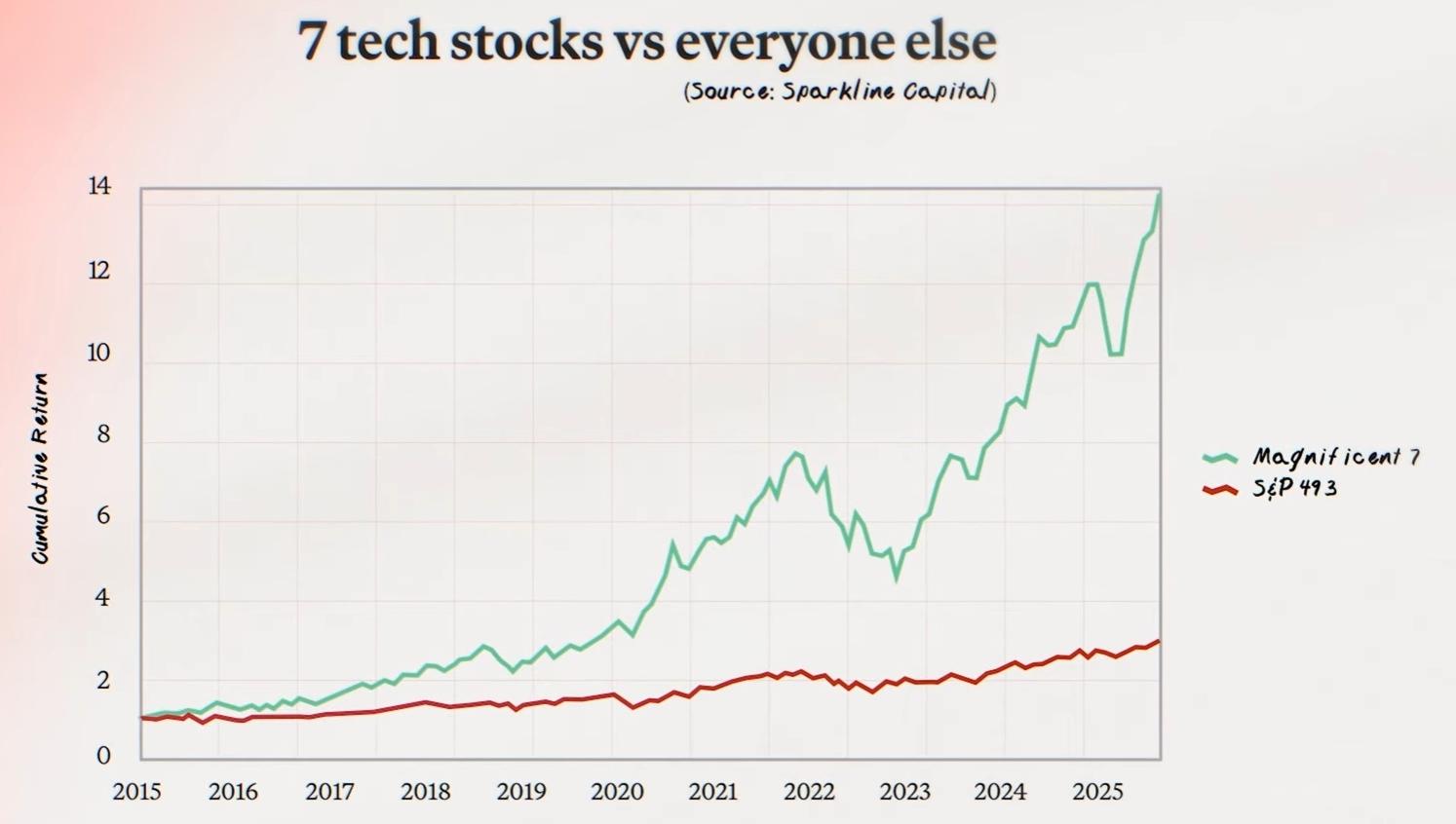
Look at that chart. The Magnificent Seven have returned roughly fourteen times their 2015 value. The other 493 companies in the S&P 500 have managed about three. The entire American stock market, the retirement savings, the pension funds, the index trackers that half the country relies on, has become a leveraged bet on seven technology companies delivering on a promise that has not yet been kept. That is not an observation about whether AI works. It is an observation about what happens to everyone’s money if the laboratory mostly produces better chatbots, or genuinely useful improvements that arrive too slowly to justify the capital already committed.
The internet changed everything. The dot-com crash still happened. AI can change the world and investors can still wildly overpay for the transformation. Those two propositions are entirely compatible, and the whole economy now has a very substantial interest in the laboratory producing something spectacular, preferably before the accountants arrive.
Then China turns up
While America builds the world’s most expensive proprietary AI infrastructure and locks the best of it behind enterprise pricing, China has taken one look at the price list and decided to attack the economics of intelligence itself. US private AI investment reached US$285.9 billion in 2025. China recorded US$12.4 billion [2]. And the model performance gap has shrunk to 2.7 points.
Moonshot’s Kimi K3 is a 2.8-trillion-parameter model reporting frontier performance across coding, reasoning and knowledge tasks [12]. DeepSeek’s V4-Flash is priced at US$0.14 per million input tokens [13], which is the kind of number that makes American infrastructure investors stare at the ceiling and reconsider their life choices. When DeepSeek’s low-cost R1 model arrived in January 2025, Nvidia lost US$593 billion in a single trading session [15].
China does not need to win every benchmark. “Almost as good for dramatically less money” is an extremely dangerous product category, roughly the equivalent of showing up at a Rolls-Royce dealership in a well-made sedan that costs a tenth of the price and corners better. And here is the geopolitical wrinkle. If American providers reserve their best capabilities for expensive enterprise contracts while trade disputes and export controls make American technology relationships more complicated, businesses outside the United States have an obvious reason to look elsewhere. To an Australian manufacturer, an Indonesian software company, an African university or a European startup, Chinese AI stops looking like China’s AI and starts looking like powerful, customisable intelligence at a price you can actually pay. Research published in 2026 argues that US technology restrictions may already have unintentionally strengthened China’s incentive to build open AI ecosystems [16]. America could find itself spending vastly more to build the most powerful engines while helping create the conditions under which everyone else shops elsewhere.
So the choice facing most of the world’s businesses and developers is becoming brutally clear. Pay the American frontier price, which is large and getting larger. Or use something cheaper, which means either having the domain expertise to steer it, or looking east. The expert and the bargain hunter end up in the same place: outside the American paywall. The only people left inside it are the ones rich enough not to care.
Two economies, one country
Max Fisher’s excellent America’s Job Market Is Collapsing [17] helped inspire this article, and his broader point is worth restating. The strange thing about America in 2026 is not that the economy is collapsing. Real GDP still grew at 1.5 per cent annualised in the second quarter [21]. The strange thing is the divergence. Non-farm payrolls fell by 23,000 in July, labour-force participation slipped to 61.4 per cent [18], the civilian federal workforce has shrunk twelve per cent since September 2024 [19], and Elon Musk appeared at CPAC brandishing a chainsaw as a symbol of cutting bureaucracy [20], which is the sort of thing editorial cartoonists would find too on-the-nose to actually draw.
America is simultaneously cutting government, disrupting trade, confronting an uneasy labour market and undertaking what Reuters calls the largest AI capital spending boom in history [10]. Perhaps AI becomes the invention engine and the wager pays off. Or perhaps AI remains amazing, automates enormous amounts of service work, companies employ fewer people, the remaining experts spend their days teaching corporate agents the knowledge that once made those experts indispensable, agentic AI consumes ever more compute, and the truly transformative inventions arrive much more slowly than Wall Street hoped. Meanwhile, Chinese companies keep making intelligence cheaper, and the best American AI keeps getting more expensive.
That would not mean AI had failed. It might mean the technology succeeded while the investment thesis failed. And that distinction could move markets, industries and ultimately the balance of economic power.
The scanner
The most valuable people in the near future may not be the people who can “use AI.” Almost everybody will be able to use AI. The advantage may belong to those who understand a field deeply enough to steer the cheaper car, because they will not need to pay for the expensive one, and they will not need to go looking for a Chinese alternative either. Expertise was supposed to be what AI replaced. It is turning out to be the only thing that keeps AI affordable.
The cars are getting faster. America is betting a sizeable piece of the garage that its car learns to invent. China is turning up with cheaper engines. Someone has already produced the chainsaw. And the price of the good car keeps going up.
Somewhere in the darkness, the little red scanner is moving from side to side, thinking it over.
References
| No. | Source | Link |
|---|---|---|
| 1 | Knight Rider opening narration. IMDb / Universal Television, Glen A. Larson, 1982. | imdb.com/title/tt0083437/quotes |
| 2 | The 2026 AI Index Report. Stanford Institute for Human-Centered AI, 2026. | hai.stanford.edu |
| 3 | Schreiter, D. Prompt Engineering: How Prompt Vocabulary affects Domain Knowledge. arXiv, 2025. | arxiv.org/abs/2505.17037 |
| 4 | Pecher, B. et al. Revisiting Prompt Sensitivity in LLMs for Text Classification. arXiv, 2026. | arxiv.org/abs/2602.04297 |
| 5 | Orlanski, G. et al. SlopCodeBench: How Coding Agents Degrade Over Long-Horizon Tasks. arXiv, 2026. | arxiv.org/abs/2603.24755 |
| 6 | Bai, L. et al. How Do AI Agents Spend Your Money? Token Consumption in Agentic Coding. arXiv, 2026. | arxiv.org/abs/2604.22750 |
| 7 | Anthropic. Manage costs effectively. Claude Code Documentation, 2026. | code.claude.com/docs/en/costs |
| 8 | Anthropic. Orchestrate subagents at scale with dynamic workflows. Claude Code Documentation, 2026. | code.claude.com/docs/en/workflows |
| 9 | Zeni, C. et al. A generative model for inorganic materials design. Nature, 2025. | nature.com |
| 10 | McGeever, J. Investors stay calm as AI capex boom eclipses dotcom mania. Reuters, 2026. | reuters.com |
| 11 | Wilson, D. and Chang, V. Are US Stock Market Valuations Outpacing Fundamentals? Goldman Sachs Research, 2026. | goldmansachs.com |
| 12 | Kimi Team. Kimi K3: Open Frontier Intelligence. arXiv, 2026. | arxiv.org/abs/2607.24653 |
| 13 | DeepSeek. Models & Pricing. DeepSeek API Documentation, 2026. | api-docs.deepseek.com |
| 14 | Reuters. Alibaba unveils its largest AI model yet. Reuters, 2026. | reuters.com |
| 15 | Reuters. DeepSeek sparks AI stock selloff; Nvidia posts record market-cap loss. Reuters, 2025. | reuters.com |
| 16 | Wang, J. et al. US Policies Unintentionally Accelerated China’s Open AI Ecosystems. arXiv, 2026. | arxiv.org/abs/2606.15999 |
| 17 | Fisher, M. America’s job market is collapsing. YouTube, 2026. | youtube.com/watch?v=aUM4kv0HnG0 |
| 18 | US Bureau of Labor Statistics. The Employment Situation, July 2026. | bls.gov |
| 19 | Rozen, C. US government workforce shrinks by 12% since September 2024. Reuters, 2026. | reuters.com |
| 20 | Associated Press. Musk waves a chainsaw and charms conservatives at CPAC. AP, 2025. | apnews.com |
| 21 | US Bureau of Economic Analysis. GDP Advance Estimate, 2nd Quarter 2026. | bea.gov |

Comments
Anyone can read. Approved members can comment. or open the join page.
Your membership is waiting for approval. You can read the thread now.
If the box below shows Sign In, choose it, then Sign In with Froodx. Once is enough.
Opened from Facebook or another app? Google does not allow sign-in inside an app's built-in browser. To comment, tap the ⋯ menu, choose Open in browser, and sign in there.